



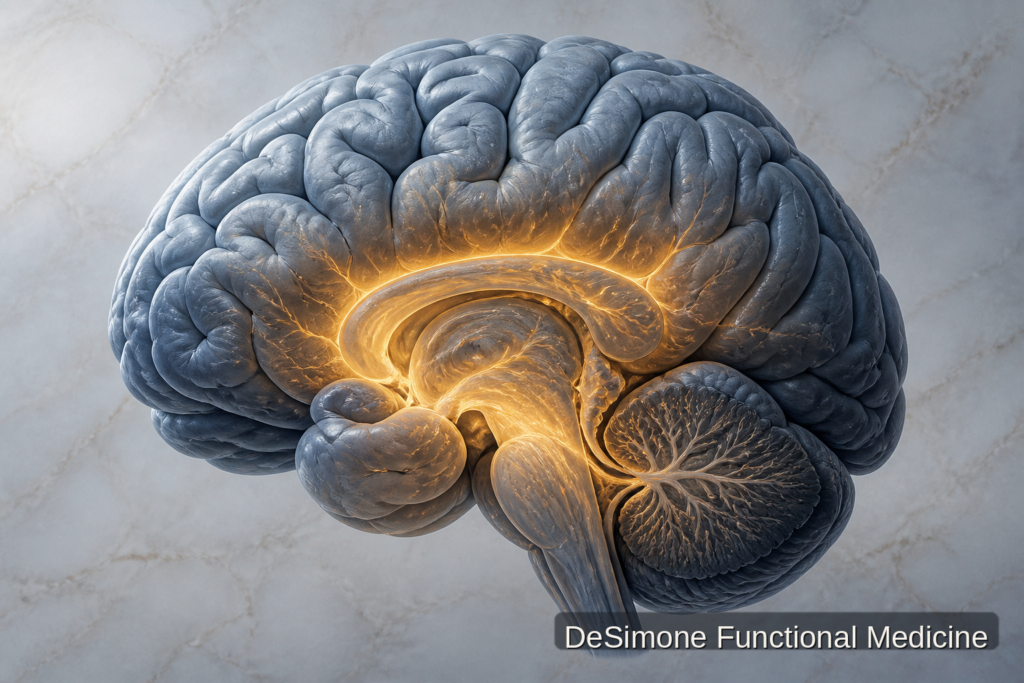
Alzheimer’s is not only plaques and tangles. One of the earliest problems is that the brain stops using glucose well. Neurons starve for energy long before memory tests fall apart.
A 2026 review in Frontiers in Nutrition (Sudasinghe and Hall) looks at whether intermittent fasting can give the brain another option.
The idea is a metabolic switch. When you go long enough without eating, insulin and glucose fall, fat is broken down, and the liver makes ketone bodies, especially β-hydroxybutyrate. The brain can burn those ketones. In Alzheimer’s, glucose transporters and insulin signaling in the brain are often impaired. Ketones do not fix that, but they can bypass some of it.
Fasting also turns down mTOR and turns up autophagy, the cell’s cleanup system. In animals, that is linked to less amyloid, less abnormal tau, calmer microglia, and more BDNF, which supports synapses. Fat tissue and muscle send their own signals (adipokines and myokines) that reach the brain. This is the same whole-person physiology we use in clinic: the brain does not live in isolation from metabolism, inflammation, and muscle.
What about people, not mice? The rodent work is consistent. Human data are thinner and more mixed. In insulin-resistant older adults, eight weeks of 5:2 fasting improved memory without a clear change in spinal-fluid amyloid and tau. In adults with mild cognitive impairment, regular fasting over three years was associated with better cognition and more ketogenesis. Other trials improved metabolic syndrome scores without helping memory. That is not a failure of the idea. It means fasting is not a drug, and cognition is not a two-week lab value.
Fasting is also not free. In older adults, especially those already losing muscle, long fasts can worsen sarcopenia if protein and resistance work are ignored. Women and men do not always respond the same way. I would not put an elderly patient with Alzheimer’s on aggressive fasting without watching weight, muscle, medications, and whether they can do it safely.
The protocol matters less than the fasting period itself. 16/8, 5:2, and alternate-day fasting all create that metabolic switch. What you eat in the window still matters. Fasting is not a license for ultra-processed food in eight hours.
If you are already in a membership plan with me, we talk about timing of meals the same way we talk about sleep, glucose, and muscle. If you are reading this and thinking of starting, talk to a physician who knows your meds and your muscle mass.
The paper is open access: https://doi.org/10.3389/fnut.2026.1839995

